Meta’s Antitrust Battle Could Reshape AI’s Future and the Social Media Landscape

Meta’s Legal Woes Threaten AI Development and Social Media Dominance
Meta, the parent company of Facebook, Instagram, WhatsApp, and Messenger, is once again in the legal spotlight. This time, the U.S. Federal Trade Commission (FTC) is intensifying its antitrust efforts, arguing that Meta’s growth-by-acquisition strategy has crushed competition—and may now impact its ambitions in artificial intelligence (AI).

The FTC’s case, first launched in 2021, accuses Meta of buying out innovative competitors to dominate the “friends and family” social networking space. If the court rules in favor of the FTC, Meta could be forced to divest Instagram, WhatsApp, and Messenger, breaking up its tightly integrated ecosystem. Such a ruling wouldn’t just reshape social media—it could cripple Meta’s data-driven AI development.
What’s at Stake: Meta’s Access to Data and AI Training Power
Mark Zuckerberg, Meta’s founder and CEO, took the stand on April 14, claiming that the way people use Facebook and Instagram has evolved. “People just kept on engaging with more and more stuff that wasn’t what their friends were doing,” he testified, suggesting Meta no longer dominates personal network content in the way the FTC alleges.
But the FTC isn’t convinced. According to its filings, Meta employed a “buy-or-bury” approach to neutralize competition. The concern is not just monopolistic behavior—it’s that Meta used its acquisitions to amass a massive pool of user data, a crucial asset in training its Llama AI models.
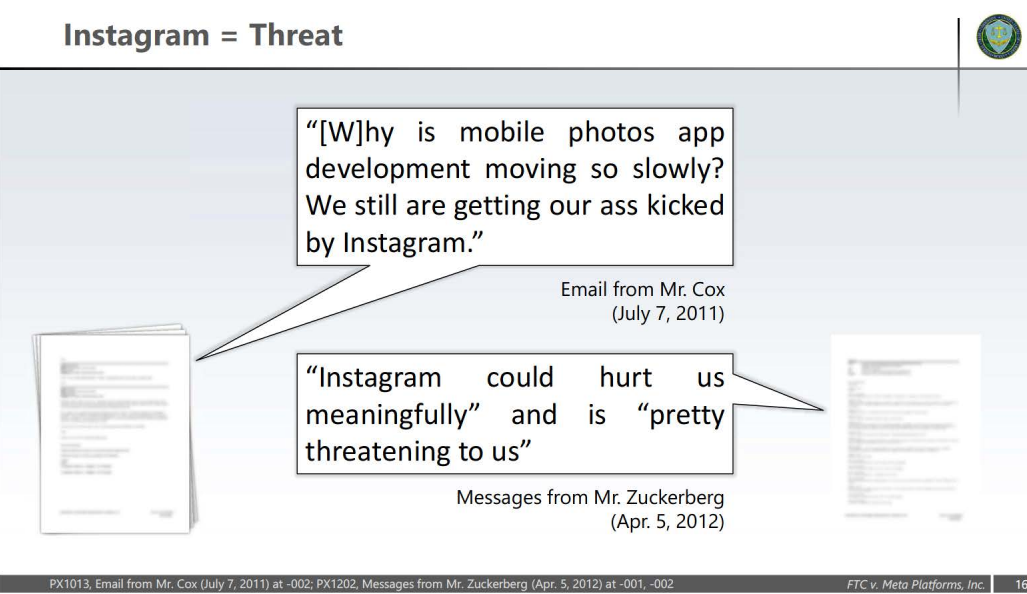
If Meta is forced to spin off its social media arms, it could lose access to oceans of data critical for maintaining a competitive edge in the AI race.
Data Privacy Concerns Already Slowing Meta’s AI Ambitions
In July 2024, Meta halted the rollout of AI models in the European Union after privacy watchdogs questioned its use of public posts for AI training. The Irish Data Protection Commission intervened after complaints were filed in 11 EU countries. Although Meta recently received approval to resume using public user data for training, a forced corporate breakup would likely complicate such permissions further.
Andrew Rossow, a cyberspace attorney, noted that without unified control over Instagram, WhatsApp, and Messenger, Meta would need to renegotiate data-sharing agreements, each subject to national laws and regulatory reviews.
AI Ambitions: Meta vs. OpenAI in a High-Stakes Race
Meta has staked a bold claim on the future of AI. In early 2025, it unveiled plans for a 2-gigawatt data center equipped with over 1.3 million Nvidia AI GPUs, a massive investment to support the expansion of its Llama AI models.
Zuckerberg wrote on Threads, “This will be a defining year for AI. In 2025, I expect Meta AI will be the leading assistant serving more than 1 billion people.”

But the pressure to keep up with OpenAI’s ChatGPT has allegedly led Meta—and others—to questionable practices. In court filings, Meta engineers admitted to scraping data from pirated books on LibGen, citing cost and time barriers to acquiring licenses legally.
Regulators Closing In: What It Means for Big Tech and AI
This case doesn’t exist in a vacuum. Similar antitrust and data privacy cases are looming for Google, Amazon, and OpenAI. But Meta’s situation is particularly pivotal. If the court rules to break up Meta’s holdings, it will set a precedent: that regulators are not only willing to redefine antitrust law for the digital age—they’re also prepared to enforce AI guardrails rooted in ethical data use and fair competition.
Rossow believes this moment is critical. He argues Meta must now choose between growth-at-all-costs or building “long-term user trust” by investing in privacy-preserving AI technologies, data transparency, and ethical innovation.
Conclusion: One Ruling, Global Consequences
The outcome of this case could shape how data is handled, how AI is developed, and whether one firm can control vast digital ecosystems. Whether Meta remains a tech titan or becomes a cautionary tale, the court’s decision will reverberate far beyond Silicon Valley.
Share This


