Ethereum’s Bold Proposal to Scale Gas Limit by 100x: A Major Step Toward Blockchain Scalability

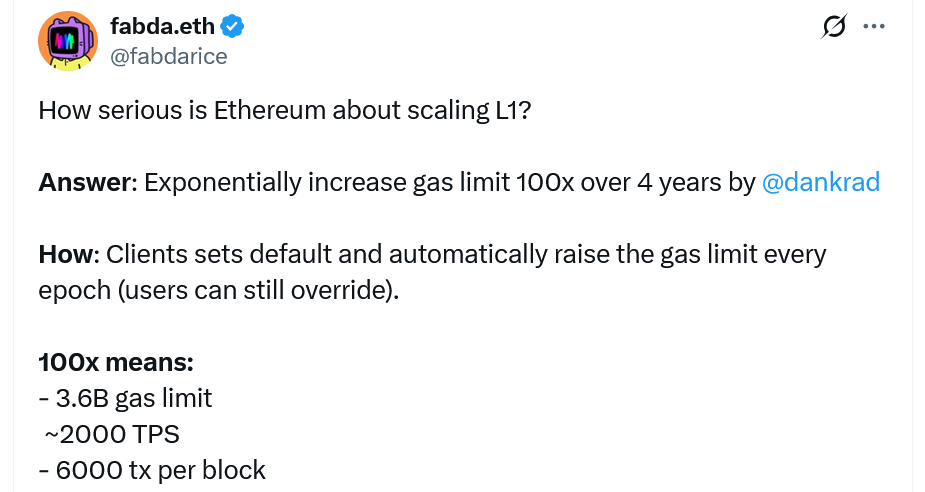
Ethereum’s quest for enhanced scalability has taken a significant leap forward with a new proposal from Dankrad Feist, a prominent researcher at the Ethereum Foundation. Feist’s Ethereum Improvement Proposal (EIP-9698), introduced on April 27, outlines a bold plan to increase the Ethereum gas limit by 100 times over the next four years. This move could dramatically boost Ethereum’s transaction processing capacity, positioning the network to compete with some of the fastest blockchains on the market.

The Path to 2,000 Transactions Per Second
Feist’s proposal aims to gradually increase Ethereum’s gas limit, starting with an incremental tenfold growth every two years. This scaling process would begin at epoch 369017, around June 1, 2025, and would continue for approximately 164,250 epochs, resulting in a 100x gas limit increase over the course of four years.
Ethereum’s current gas limit of 36 million would increase to a staggering 3.6 billion, allowing up to 6,000 transactions per block. This expansion could significantly boost Ethereum’s transactions per second (TPS), theoretically reaching 2,000 TPS, a dramatic leap from its current capacity of up to 20 TPS.
Why This Matters: Competing with Solana and Beyond
This major scaling initiative comes at a critical time for Ethereum as it seeks to stay competitive with fast-growing blockchains like Solana, which processes between 800 and 1,050 TPS in practice, with a theoretical maximum of 65,000 TPS. Feist’s proposal could position Ethereum as a serious contender in the race for the blockchain with the highest scalability.
Feist’s plan would not only make Ethereum more efficient but would also align the network with advancements in hardware and protocol efficiency, ensuring sustainable growth in the long term. Ethereum’s potential for greater scalability could open doors for more robust decentralized applications (dApps) and improved user experiences.
A Gradual Approach to Network Optimization
While the proposal has significant potential, it also presents certain challenges. Feist acknowledges that a rapid increase in the gas limit may place stress on less-optimized nodes, which could lead to longer block propagation times. However, he reassures the community that the exponential schedule will allow for gradual adjustments, providing node operators and developers ample time to optimize the network.
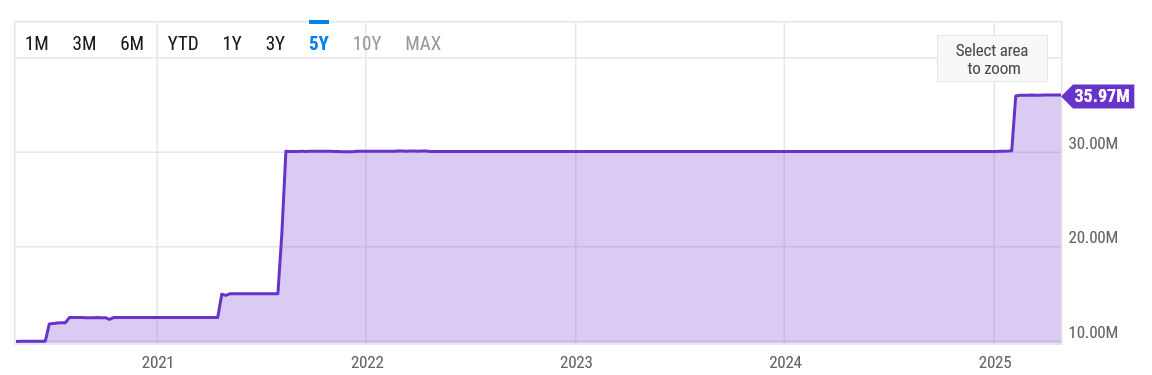
Feist’s proposal follows Ethereum’s successful move earlier this year, when validators agreed to raise the gas limit from 30 million to 36 million in February. This recent change, part of Ethereum’s ongoing efforts to scale its base layer, follows the London hard fork in 2021, which raised the gas limit from 15 million to 30 million.
EIP-9698: A Step Toward Layer-1 Scalability
EIP-9698 represents a strategic shift in Ethereum’s approach to scalability, marking a move back toward base-layer scaling after several years of focusing on Layer 2 solutions. Layer 2 networks, while efficient, have fragmented the Ethereum ecosystem, creating multiple siloed chains with limited interoperability. Critics argue that this has resulted in a poorer user experience, making EIP-9698 a welcome development for those seeking scalability improvements directly on Ethereum’s mainnet.
What’s Next for Ethereum’s Gas Limit?
The proposal is part of a larger movement within the Ethereum community to address scalability issues at the base layer, with EIP-9678 also exploring the possibility of a fourfold increase to the gas limit in the upcoming Fusaka hard fork, scheduled for late 2025. Meanwhile, Ethereum’s next major upgrade, Pectra, is set to go live in May 2025, bringing further improvements to the network’s performance.
Share This


