Morgan Stanley Files Amended SEC Application for Its Own Spot Bitcoin ETF — Ticker: MSBT
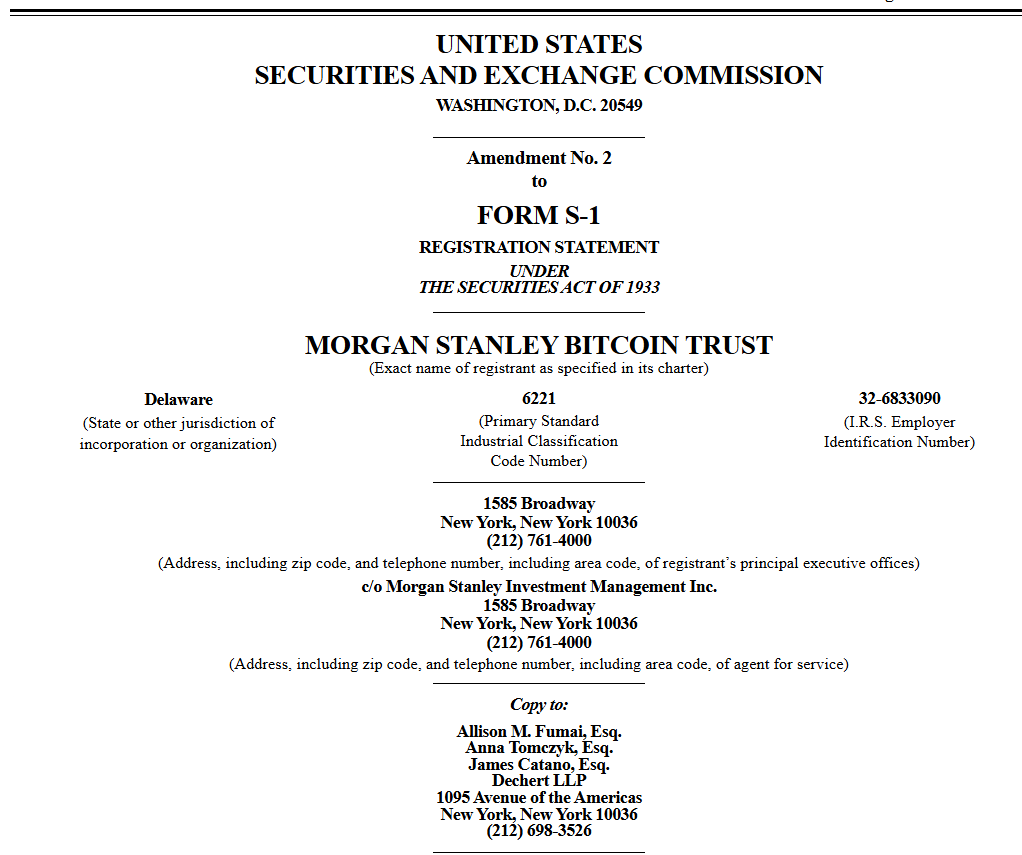
Morgan Stanley is no longer content to distribute someone else’s Bitcoin product. The Wall Street giant has filed a second amended S-1 registration with the US Securities and Exchange Commission for its own spot Bitcoin exchange-traded fund, set to trade under the ticker MSBT — a move that signals a fundamental shift in how the bank intends to participate in the crypto investment market.
From Distributor to Issuer: What the Filing Reveals
The amended S-1 outlines the mechanics of how MSBT would come to market. The trust plans to raise $1 million through the sale of 50,000 seed shares to a delegated sponsor prior to listing on NYSE Arca. Those proceeds would then be used to purchase Bitcoin directly for the fund, establishing the initial asset base before public trading begins.
The filing also names the fund’s authorised participants — Jane Street, Virtu Americas and Macquarie Capital. These are the institutional intermediaries responsible for creating and redeeming large blocks of ETF shares, a mechanism that keeps the fund’s market price tightly anchored to Bitcoin’s underlying value by allowing arbitrage when the two diverge. The selection of three well-established liquidity providers signals that Morgan Stanley is building serious market infrastructure around this product, not treating it as an experiment.
The fund remains subject to full regulatory approval before trading can commence.
Why This Is a Bigger Deal Than Another Bitcoin ETF
The distinction between distributing a Bitcoin ETF and issuing one is significant — and deliberately strategic. Morgan Stanley has until now offered clients access to BlackRock’s IBIT, the dominant spot Bitcoin ETF launched in January 2024. By launching MSBT, the bank transitions from earning distribution commissions on a competitor’s product to collecting management fees on its own.
Marcin Kazmierczak, co-founder of blockchain data provider RedStone, put the strategic logic succinctly: “Morgan Stanley is moving from distributing BlackRock’s IBIT to issuing its own product, capturing management fees directly rather than earning distribution commissions.” He added that the bank’s 15,000 financial advisors represent genuine “distribution muscle” that few asset managers can match — a built-in sales force that could drive substantial inflows from day one.
That advisor network already has a mandate to work with crypto. In October 2025, Morgan Stanley recommended a 2% to 4% allocation to crypto for investors and financial advisers, and extended that guidance to clients holding individual retirement accounts and 401(k)s — meaning MSBT, if approved, would have an immediate and receptive audience within the bank’s own client base.
Wall Street’s Crypto Push Is Accelerating
Morgan Stanley’s filing does not exist in isolation. It is the latest move in a broader and accelerating shift among major US financial institutions toward mainstream crypto product offerings.
Bank of America, the second-largest US bank by assets, began allowing wealth management advisers to proactively recommend exposure to four spot Bitcoin ETFs from January 5, 2026 — products that had previously only been available to clients who asked. A day before that, Vanguard — the world’s second-largest asset manager and historically one of the most sceptical voices on crypto — reversed its long-standing position and enabled Bitcoin ETF trading for its clients.
BlackRock, meanwhile, recommended up to a 2% Bitcoin allocation to its clients back in December 2024, lending institutional credibility to crypto as a legitimate portfolio component at a time when many advisers were still reluctant to raise the subject.
The pattern is consistent: firms that spent years on the sidelines are now moving decisively, and the speed of that movement is compressing. What took years to shift in attitude is now translating into product launches, policy changes and amended SEC filings in a matter of months.
What Approval Would Mean
If the SEC grants approval, MSBT would enter a competitive but still-growing market for spot Bitcoin ETFs. BlackRock’s IBIT has dominated flows since its launch, but Morgan Stanley’s distribution network and existing client relationships give MSBT a credible path to gathering assets quickly.
For retail and institutional investors, the practical effect is straightforward: another regulated, brokerage-accessible route to Bitcoin exposure — this time backed by one of Wall Street’s most recognisable names and available through advisers already sitting across the table from millions of clients.
For the broader crypto market, it is another data point in the same direction: Bitcoin is becoming a standard allocation in professional portfolio management, and the institutions building that infrastructure are no longer the early adopters. They are the mainstream.
Share This


