Aave Oracle Error Sparks $27M Liquidations, Protocol Moves to Repay Users
Pricing Misconfiguration Triggers Forced Liquidations in DeFi Lending Market
A technical error inside the risk-oracle system used by decentralized lending protocol Aave triggered about $27 million in forced liquidations, prompting the platform to step in and compensate affected users.
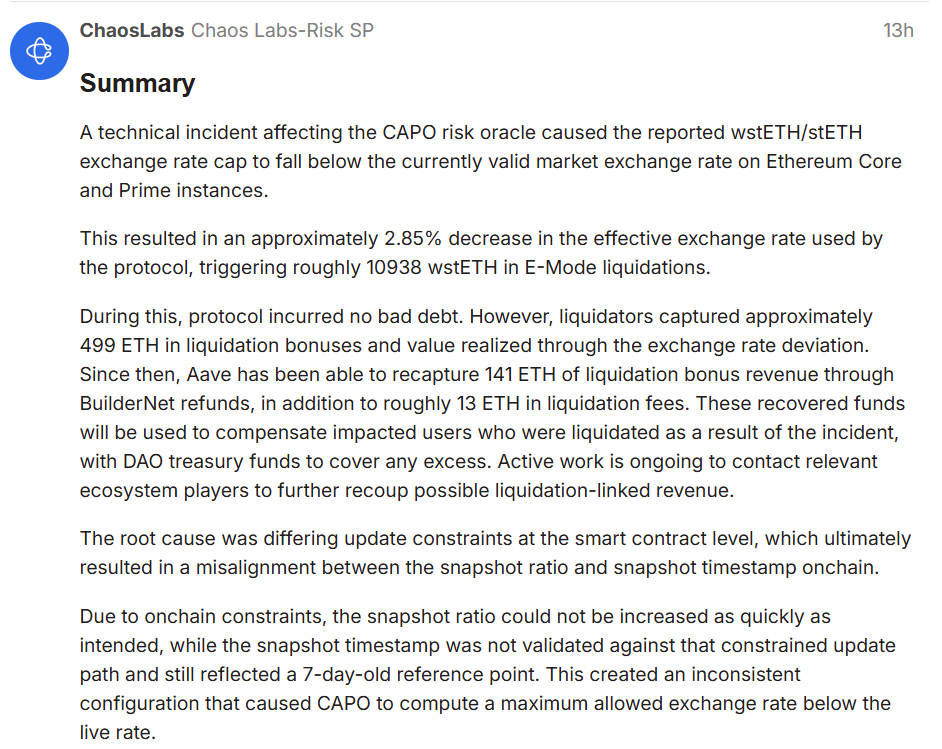
According to a post-mortem released Tuesday, 10,938 wrapped staked Ether (wstETH) positions were liquidated after the system calculated an exchange rate 2.85% below the live market rate for assets tied to Ether and Lido staking derivatives.
The incident was caused by a mismatch between pricing parameters and timestamp data within the oracle configuration, which resulted in the system approving a maximum exchange rate lower than the actual rate recorded onchain.
Despite the disruption, Aave stated that the protocol itself did not incur bad debt, though liquidators captured substantial rewards from the event.
Liquidators Earn Bonuses as Price Deviation Hits Borrowers
Nearly 500 ETH Captured Through Liquidation Incentives
Because of the pricing discrepancy, liquidators were able to claim about 499 ETH in bonuses and related liquidation value tied to the price deviation.
The external oracle tool involved—Chaos Risk Oracles, integrated into Aave’s infrastructure—had previously processed more than 1,200 payloads and 3,000 parameters without incident, according to Aave founder and CEO Stani Kulechov.
Kulechov said the error was a technical misconfiguration affecting positions already close to their liquidation thresholds.
“The configuration issue has already been remediated,” he said in a statement, adding that the protocol itself avoided financial damage from the incident.
Still, liquidators received 345 ETH (roughly $700,000) as an excess liquidation windfall tied directly to the pricing misalignment.
Aave Moves to Repay Impacted Borrowers
Treasury Funds Will Cover Remaining Losses
In response, Aave said it has begun assembling funds to compensate users whose positions were liquidated due to the oracle error.
The protocol has already recovered 141 ETH (about $285,000) through BuilderNet refund mechanisms, along with another 13 ETH in liquidation fees. These funds will be directed toward affected users.
If compensation requires additional capital, Aave’s DAO treasury will cover the remaining shortfall, the team said.
The event has renewed attention on oracle reliability and collateral pricing in decentralized finance lending markets, where automated liquidation systems rely heavily on accurate real-time price feeds.
DeFi Security Under Pressure
Recent Attacks Raise Questions About Risk Controls
The liquidation episode comes amid broader concerns about price manipulation and oracle vulnerabilities in DeFi lending protocols.
In late February, attackers drained roughly $10 million from a lending pool managed by YieldBlox DAO, which was built on the Blend Protocol lending framework, through a price manipulation attack.
Such incidents have intensified calls for stronger safeguards in decentralized lending platforms where billions of dollars in collateral are managed through automated smart contracts.
Governance Dispute Adds Pressure Inside the Aave Ecosystem
DAO Leadership Debate Intensifies
The liquidation event also comes during a period of tension within the Aave community.
Earlier this month, the Aave Chan Initiative announced it would not renew its engagement with the Aave DAO, citing concerns about governance practices and voting dynamics.
Kulechov has since argued that blockchain governance models relying solely on token-holder voting may not be sufficient for managing complex protocols.
Running a major blockchain system, he said, requires clear leadership and technical oversight rather than thousands of competing votes that can slow decision-making or politicize protocol upgrades.
The debate reflects a broader challenge facing decentralized finance: balancing community governance with operational stability in systems that handle large pools of digital assets.
Share This


