Vitalik Buterin Warns Against Single Digital IDs, Pushes for Pluralistic Systems
Ethereum co-founder Vitalik Buterin says privacy must not be sacrificed in the name of progress, as he introduces a decentralized and diverse approach to digital identity.
One ID to Rule Them All? Buterin Urges Caution
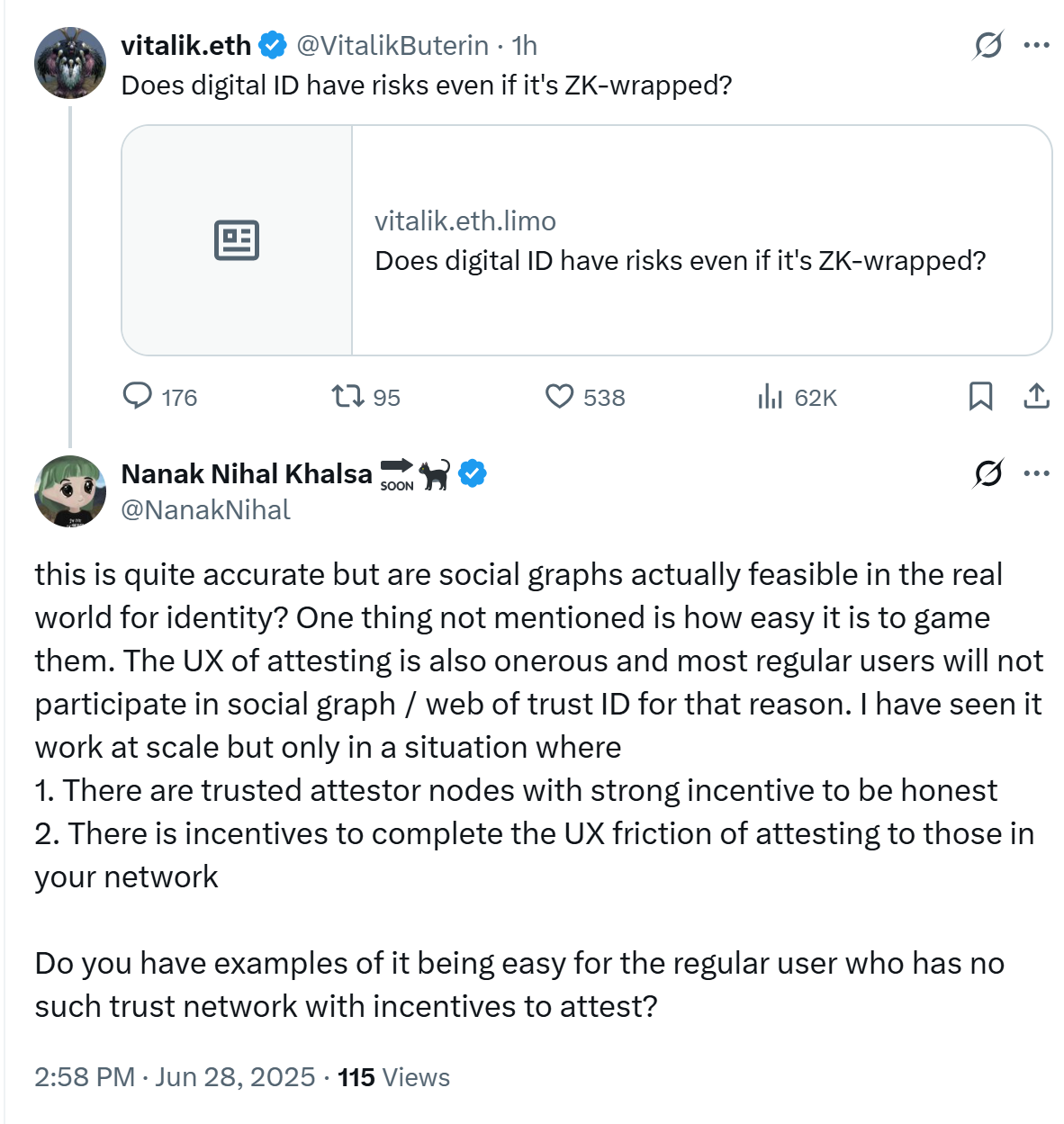
In a new blog post, Ethereum’s Vitalik Buterin sounded the alarm on the risks of enforcing a single digital identity per person, even if wrapped in zero-knowledge (ZK) proofs. While these privacy-preserving systems have been touted as the future of digital ID — used by platforms like World ID (now serving over 10 million users), Taiwan’s national digital ID project, and emerging EU initiatives — Buterin warns they may inadvertently undermine pseudonymity and digital freedom.
Source: Buterin
“ZK-wrapping solves a lot of important problems,” Buterin acknowledged, but added that it does not solve all of them. When every user is locked into one verifiable identity, it removes the option to have multiple pseudonymous accounts, a cornerstone of personal freedom and safety online.
Buterin stressed that the flexibility to maintain multiple identities across contexts is essential in a digital world dominated by surveillance and social scoring. Without this, users could be forced to live entirely under a single public profile, accessible to governments, corporations, and employers.
He also criticized systems that rely solely on proof of wealth to combat fake accounts, warning this excludes the poor and centralizes power. “The theoretical ideal,” he proposed, “is where you can get N identities at a cost of N²,” making Sybil attacks expensive while keeping the door open for inclusive participation.
Introducing Pluralistic Digital Identity
To address these issues, Buterin proposed ‘pluralistic identity’, a model that relies on multiple identity providers, both public and private. Rather than a single gatekeeper, identities would be derived from various systems — including government-issued IDs, social networks, and blockchain-based verification tools.
This approach, he wrote, allows for a more inclusive and error-tolerant system, particularly helpful for stateless individuals or those without access to traditional ID frameworks.
“Any form of pluralistic identity… is naturally more error-tolerant,” Buterin noted.
The Long-Term Vision: Merging the Best of Both Worlds
Buterin sees a future where one-per-person systems are balanced by social-graph mechanisms, ensuring neither dominates. If any single system grows too large, it risks locking users into universal exposure and rigid structures.
The best outcome, he argues, is a diverse identity ecosystem, where verification is possible without compromising privacy, autonomy, or access.
“If their market share gets too close to 100%, they shift the world… to a one-per-person model, which has worse properties,” Buterin warned.
Rhapsody of Realities is a life guide that brings you a fresh perspective from God’s Word every day. It features the day’s topic, a theme scripture, the day’s message, the daily confession and the Bible reading plan segment. It is God's Love Letter to You!