Utah Moves to Ban Prediction Markets, Setting Up Legal Fight With Federal Regulators
New Gambling Bill Targets Platforms Like Kalshi and Polymarket
The U.S. state of Utah is moving to block online prediction market platforms, including Kalshi and Polymarket, escalating a growing clash between state regulators and federal authorities over who controls the emerging industry.
Lawmakers have approved HB243, known as the Gambling Revisions bill, which classifies certain forms of “proposition betting” as gambling. The legislation now sits on the desk of Spencer Cox, the state’s governor, who has indicated he intends to sign it into law.
If enacted, the measure would prohibit companies from offering sports-related prediction contracts in Utah, including platforms that market themselves as prediction markets rather than sportsbooks.
The move places Utah at the center of a broader national debate about how digital betting markets tied to real-world events should be regulated.
Utah’s New Law Targets Proposition Betting
Lawmakers Aim to Prevent Sports-Based Event Wagers
Utah’s HB243 bill passed the Utah House on Feb. 10 and cleared the Utah Senate on Feb. 27, setting the stage for the governor’s approval.
The legislation defines proposition bets—wagers on specific in-game outcomes—as gambling.
Examples of proposition betting include wagers on:
-
An individual athlete’s performance
-
Whether a team reaches a specific statistic
-
Other events within a game rather than the final result
By defining these bets as gambling, lawmakers aim to block companies from offering sports-related prediction markets to Utah residents, even if the platforms frame them as financial event contracts.
Governor Cox has been outspoken about the risks of online betting platforms.
According to reporting from the Associated Press, Cox warned that digital betting products could spread widely through mobile apps.
“We are putting a casino in the pocket of every single American,” Cox reportedly said, adding that such platforms are increasingly targeting younger users.
Kalshi Takes Utah to Court
Platform Claims Federal Law Protects Its Event Contracts
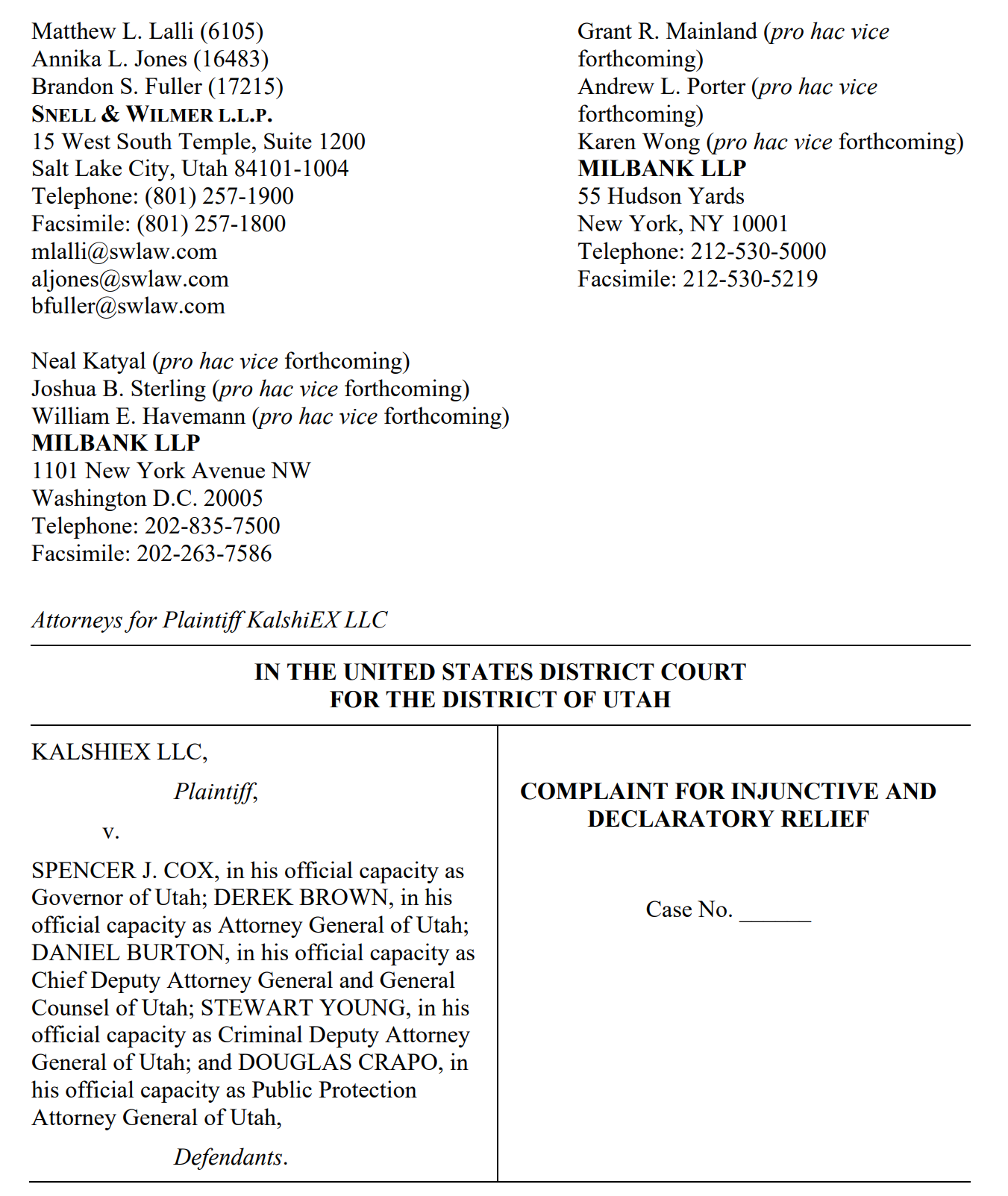
The legal conflict escalated earlier this year when Kalshi filed a lawsuit against Utah, asking a federal judge to prevent the state from enforcing the new restrictions.
The company argues that its event contracts are federally regulated financial derivatives rather than gambling products.
Kalshi says the Commodity Futures Trading Commission (CFTC) has exclusive regulatory authority over its markets under the Commodity Exchange Act.
If that interpretation holds, the company claims, states would not have the power to ban such markets individually.
Parallel Legal Battles Across Multiple States
The dispute is not limited to Utah.
Kalshi also filed a lawsuit against the state of Iowa, citing concerns that regulators there could soon take enforcement action against its sports event contracts.
Meanwhile, in Ohio, a federal judge recently rejected Kalshi’s request to block state regulators from applying gambling laws to the company’s contracts tied to sporting events.
The cases suggest a growing patchwork of legal fights across the United States, as states attempt to regulate or restrict prediction markets while federal regulators assert broader jurisdiction.
Federal Regulators Signal They Will Defend Their Authority
CFTC Says Prediction Markets Fall Under Federal Oversight
The CFTC has made it clear that it views prediction markets as falling within its regulatory authority.
Michael Selig, chairman of the agency, recently warned that the commission would defend that authority in court if challenged.
“To those who seek to challenge our authority in this space, we will see you in court,” Selig said during remarks at an industry conference in Florida.
Selig also argued that well-functioning prediction markets can serve a valuable purpose.
He described them as “truth machines,” suggesting that markets where participants risk money on outcomes may provide more reliable signals about future events than traditional opinion polls.
A Defining Moment for the Future of Prediction Markets
The legal battles unfolding across several states could determine whether prediction markets are treated as financial derivatives or as a new form of online gambling.
If states succeed in restricting the platforms, companies like Kalshi and Polymarket may face a fragmented regulatory landscape across the United States.
But if federal regulators prevail, prediction markets could gain stronger legal footing nationwide, potentially expanding into areas ranging from sports and politics to economic forecasting.
For now, Utah’s pending legislation marks one of the most aggressive attempts by a state government to halt the growth of these platforms.
Share This


